
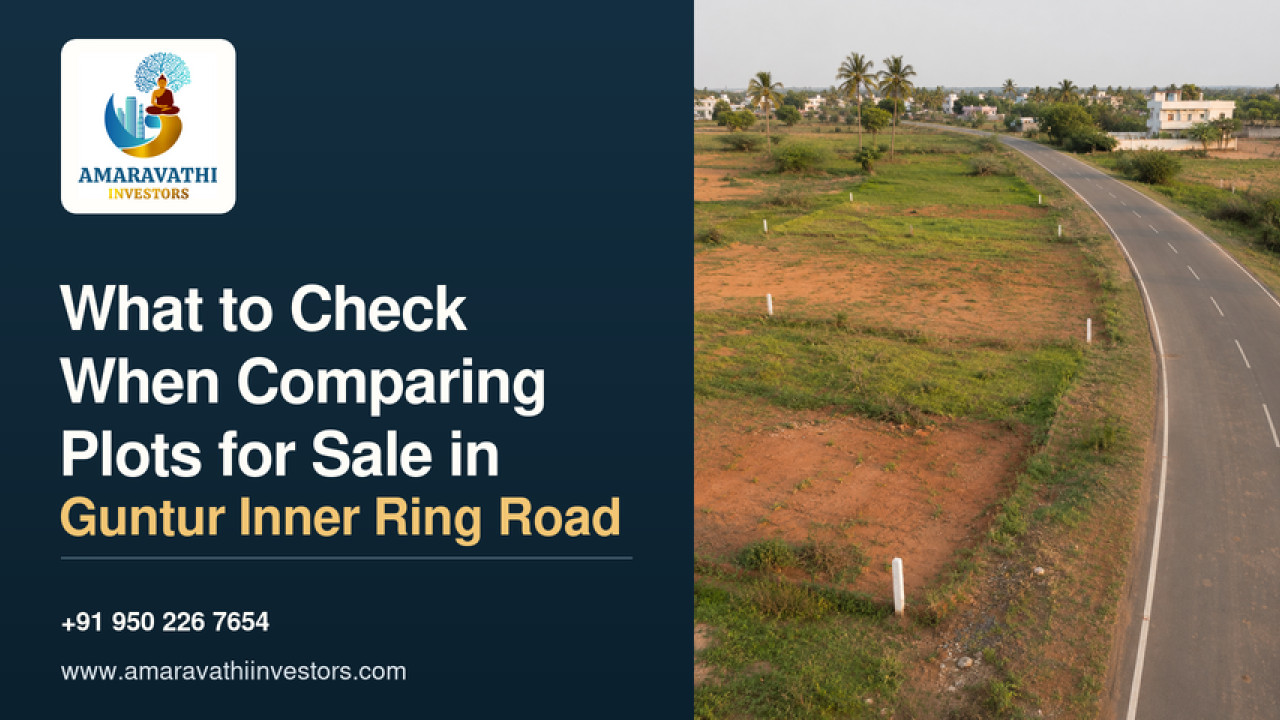
When comparing plots for sale in guntur inner ring road, start with the survey number, seller’s title, sanctioned layout and actual approach road. These checks tell you whether the plot you visit matches the one you can buy and use. Then compare drainage, utilities, dimensions and the full purchase cost. Two listings may name the same stretch of road and quote similar rates, yet one may involve a longer daily drive, more site preparation or an access question that takes months to resolve.
Pinpoint the plot and the road you would actually use
Ask for the plot number, survey number and subdivision, revenue village, mandal and a location pin at the plot entrance. Cross-check them against the deed schedule and the sanctioned layout. If a listing uses the name of a nearby neighbourhood, keep that name for navigation and use the revenue details to search official records. A pin at the sales office or layout gate gives you little help when you need to find the exact boundaries.
Check which road the listing refers to. Guntur city’s Inner Ring Road and the Amaravati region’s Inner Ring Road alignment can both appear in searches for land around Guntur. If a listing mentions Amaravati Road, Gorantla or Pedapalakaluru, ask for the junction and the route from there to the plot. Drive it at the time you would normally travel to work or school. Note junction delays, turning restrictions and any detour you would need to reach the site from the opposite direction.
Match the plot to the sanctioned layout
Request the layout permission number, approval proceedings and a legible copy of the sanctioned plan. Use the revenue village and survey details to identify the authority responsible for that parcel. Where the Andhra Pradesh Capital Region Development Authority (APCRDA) issued the approval, check its approved layout records and ask the authority to confirm any details you cannot verify. Match the plot number, phase, dimensions and abutting road width to the plan.
Check what the plan shows immediately around the plot. A strip advertised as extra frontage may form part of the road reservation. A neighbouring space marketed as open land could serve as a park or amenity under the approved plan. Ask whether a revised plan supersedes the copy you received and whether the authority holds any plots as security for development works. If it does, verify the release status of the particular plot before you proceed.
Check AP RERA registration where it applies
For a promoter’s plotted development, ask whether the project or phase requires registration with the Andhra Pradesh Real Estate Regulatory Authority (AP RERA). If it does, look up the registration number and match the promoter, location and phase to the offer. Compare the recorded completion date and infrastructure commitments with the payment schedule. If the promoter claims an exemption, ask for its basis in writing. Layout sanction, project registration and the seller’s legal right to sell each require a separate check.
Trace ownership and verify the seller’s right to sell
Ask an independent property lawyer to review the title chain, starting with the seller’s registered deed and the prior deeds needed to trace ownership. Reconcile survey numbers, subdivisions, boundaries and areas across the documents. If the seller inherited the land, check who acquired rights and whose signatures the sale requires. If a developer sells under an agreement with the landowner, verify who can convey the specific plot. Where someone signs under a power of attorney, check its scope and validity.
Obtain a current encumbrance certificate (EC) covering the period and parcel identifiers your lawyer recommends. Check the registered transactions it records, including mortgages and any matching releases. Ask your lawyer to investigate disputes, claims and restrictions that the certificate may miss. Check the plot and its parent land against applicable prohibited property records. Compare relevant revenue and survey records with the deeds, including the Record of Rights, Adangal or land parcel details where available. Follow up on discrepancies before you agree to a payment date.
Confirm legal access and check land use
Trace the approach from the public road to the plot. A route may look open during a visit because vehicles cross an adjoining parcel with the owner’s permission. Ask the seller to show the legally available route on the sanctioned layout or in the relevant deeds. Where the approach depends on a private passage, ask your lawyer to verify the access right, its width and whether it passes to you with the purchase.
Ask the planning authority which land use applies and whether a road alignment, widening line, waterbody buffer, drain reservation or utility corridor affects the parcel. If the records show agricultural use or a different classification from what the seller claims, establish which conversion or planning permissions apply to your intended use. Show the plot dimensions and road width to a local architect if you plan to build. Setbacks, access requirements and other building controls determine how much space you can actually use.
Walk the boundaries and look for signs of waterlogging
Ask a qualified surveyor to identify the corners and compare the measured dimensions, area and boundaries with the sanctioned plan and deed schedule. Check whether compound walls, neighbouring extensions or utility poles affect the site. Note which side provides frontage. For example, a rectangular 30-by-60-foot plot measures 200 square yards, and turning that rectangle so the longer side faces the road changes where you might place an entrance, parking space or staircase.
Look at the plot from the road and then from its lowest corner. Is it below the road surface? Where would rainwater go if the roadside drain filled up? Check for silt marks, standing water and freshly dumped fill. Visit after rainfall if possible and ask nearby occupants how the approach road behaves during heavy rain. If the site needs substantial filling, drainage work or a retaining wall, get a site-specific estimate before treating its lower asking price as a saving.
Find out which services your plot can use
Check the power connection, water source, stormwater outlet and sewage arrangements at the plot’s street. A road with poles can still require additional work to connect a particular plot. If the promoter promises water lines or underground drainage, ask where they terminate, who will connect them and what the buyer pays. Also confirm how the layout handles household wastewater if a sewer connection does not serve the street.
Walk the internal road beyond the entrance. Look for finished surfaces, usable drains, working lights and room for vehicles to pass. Ask who maintains roads and shared spaces, how charges accrue and whether the relevant body has taken over any completed infrastructure. If you expect to build soon, check whether construction vehicles can reach the plot and where they could unload. Access that feels adequate in a car may prove awkward for deliveries.
Compare the full cost per square yard
Request an itemised quote showing the base price, premiums, development and maintenance charges, brokerage where applicable, and statutory costs. Add any immediate spending you anticipate for filling, fencing, access improvements or service connections. Use the measured and documented area to calculate an effective rate. Divide total acquisition and immediate preparation costs by the area in square yards. Keep ongoing expenses, such as interest and future maintenance, visible in a separate budget line.
Consider two hypothetical plots, each measuring 200 square yards. Compare the amount you expect to spend before you can use the land. The example uses illustrative figures in rupees.
| Cost item | Plot A | Plot B |
|---|---|---|
| Quoted price per square yard | ₹25,000 | ₹26,000 |
| Base plot price | ₹50,00,000 | ₹52,00,000 |
| Other purchase and immediate preparation costs | ₹4,80,000 | ₹2,20,000 |
| Total estimated outlay | ₹54,80,000 | ₹54,20,000 |
| Effective cost per square yard | ₹27,400 | ₹27,100 |
Plot A starts ₹1,000 lower per square yard and costs ₹60,000 more in total. In a real comparison, check which items the seller has already included so you avoid counting them twice. Ask for a registration cost estimate for the actual transaction and verify the applicable valuation basis. Use recent transactions for similar plots as a price check where reliable records are available, and compare properties with similar access, approval status and infrastructure.
If you plan to borrow, ask the lender which documents it needs for a vacant plot and whether it will lend on your chosen layout. Allow time for its legal and technical checks before agreeing to a payment deadline. Ask how the agreement handles a delayed or declined loan and whether you could cover any shortfall in the sanction amount.
Decide how much the location matters to your plans
If you want to build and move in, compare the trips your household makes every week. Check time to work, school, healthcare and shops using the actual approach road. Visit during evening traffic to gauge noise, street lighting and the ease of entering the lane. A plot set back from the main road may suit a household that prioritises a quieter street, provided the last stretch works in all seasons.
If you expect to hold the plot for several years, look at maintenance costs, ease of monitoring the boundaries and likely demand from future buyers. Nearby occupied homes can help you assess how the area functions. Give proposed infrastructure its own entry in your comparison. If a seller’s price depends on a future road connection, ask what happens to your travel time and resale prospects if that connection takes longer than expected.
Get the payment and handover terms in writing
Request the draft agreement before you pay a token or booking amount. Check that it identifies the plot, phase, survey details, total consideration, payment dates and time allowed for document review. Agree on who must resolve title or boundary discrepancies and how the refund works if the transaction cannot proceed. If the seller promises roads, utilities or other works, ask for specific obligations and dates in the agreement. Make payments through traceable channels and collect receipts that identify the plot.
Confirm who will sign the sale deed, when the seller will hand over physical possession and how you will receive the relevant documents. Arrange a final site visit if the seller agreed to mark boundaries, improve access or complete other work before closing. At Amaravthi Investors, we suggest recording the date, estimated cost and remaining questions for each shortlisted plot. Keep a copy of every version of the price sheet and approved plan that the seller provides.
Resolve any discrepancies before deciding between two plots
Put the verified facts for each plot on one page. Start with the items that could prevent a purchase or block your intended use. Examples include an unresolved mortgage, a mismatch between the deed and site measurements, a disputed approach road or a survey parcel affected by a planned road. Record what document or site check would settle each question, who will obtain it and when you expect an answer.
Once both plots clear those checks, weigh the differences that affect your plans. A higher price for wider frontage may make sense if your architect can use that frontage for parking and a workable floor plan. Paying extra for a corner may add little value if traffic noise affects the rooms you intend to place there. If the seller claims a premium, ask what practical advantage you would gain and whether you would still pay for it after allowing for all other costs.
Final checks before choosing a plot
Before committing to a plot near Guntur Inner Ring Road, verify the seller’s title, layout, boundaries and legal access. Visit the exact parcel, check drainage and utilities, and compare the full cost against your budget. Use travel times and current road conditions to judge whether the location fits your plans. Ask for written answers where the purchase depends on a release, repair or future connection. Choose the plot whose verified access, buildable area and total cost fit the use you have in mind.
FAQs
1. What should I check first when comparing plots near Guntur Inner Ring Road?
Ask for the plot number, survey number and subdivision, revenue village, location pin and layout permission details. Match them against the sanctioned plan and the seller’s deed. Visit the specific plot and follow the actual approach road from the nearest usable junction.
2. How do I verify layout approval for a residential plot near Guntur Inner Ring Road?
Get the layout permission number, approval proceedings and latest sanctioned plan from the seller. Confirm the approval with the planning authority that issued it. Check that the survey number, plot number, phase, dimensions and abutting road match the official plan.
3. Do all plots near Guntur Inner Ring Road require AP RERA registration?
AP RERA registration applies to plotted development projects that come within the registration requirements. Check the relevant project phase when buying from a promoter. If the promoter claims an exemption, ask for the specific basis and have it verified before paying a booking amount.
4. Which documents should I ask for before buying a plot near Guntur Inner Ring Road?
Ask for the seller’s registered deed, ownership chain documents, an updated encumbrance certificate, layout sanction and relevant revenue or survey records. Depending on the plot, you may also need a mortgage release, proof of access, land-use or conversion records, or documents showing the seller’s authority to sign.
5. How can I check whether road widening affects a plot near Guntur Inner Ring Road?
Give the survey number, subdivision and plot plan to the relevant planning authority. Ask it to check the parcel against the latest applicable road alignment and widening plans. If a reservation crosses the plot, ask a surveyor to show how much area it affects.
6. How do I compare the price per square yard for two plots in Guntur?
Divide each plot’s total purchase and immediate preparation costs by its verified area in square yards. Include registration expenses, plot premiums, development charges and site work where applicable. Compare that effective rate with recent transactions for plots with similar access, approvals and services.
7. How can I check for waterlogging before buying a plot near Guntur Inner Ring Road?
Visit after rainfall if possible. Compare the plot level with the road, trace where stormwater drains and check the entrance for standing water. Ask neighbours whether access becomes difficult during heavy rain. Get an estimate for any filling or drainage work the plot needs.
8. Can I build a house immediately after buying a plot near Guntur Inner Ring Road?
Your ability to start construction depends on the applicable land use, site conditions and building permission requirements. Ask a local architect to check the road width, setbacks and usable building area. Confirm the permission process and timing before setting a construction date.
9. Is a corner plot near Guntur Inner Ring Road worth paying more for?
A corner plot may justify a premium if the second road frontage improves access, parking or the house layout. Ask an architect to account for applicable setbacks, then check traffic noise, turning movement and privacy on both sides before deciding what the extra frontage is worth to you.
10. What should a booking agreement for a Guntur Inner Ring Road plot include?
It should identify the exact plot and payment amount, state whether the seller will credit the booking amount towards the price, and spell out the refund terms. Include a deadline for document review and clarify what happens if a title, approval or measurement issue prevents the sale.