
A retired schoolteacher from Guntur put her savings of ₹18 lakhs into a plot near Prathipadu in 2019. The layout looked good. The brochure had photographs of wide roads and drainage lines. The broker assured her the papers were clean. Three years later, she found out the layout had no municipal approval, the roads existed only in the brochure, and the seller had vanished. She spent two more years and nearly ₹2 lakhs in legal fees trying to recover something.
Situations like hers happen across Andhra Pradesh every year. Not because buyers are careless, but because unapproved layouts are everywhere, they look identical to approved ones from the outside, and by the time problems surface, money is already committed.
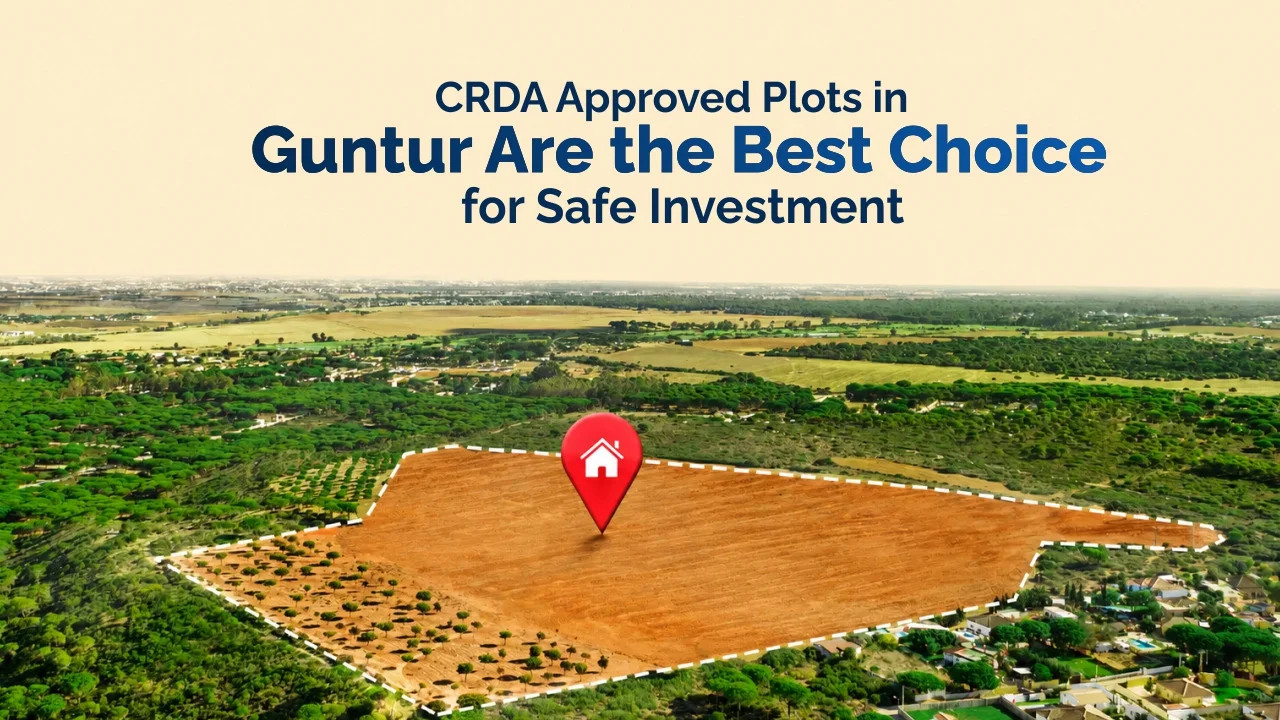
The core reason CRDA approved plots in Guntur stand apart is simple: the Capital Region Development Authority has already done the legal and planning verification before you ever see the site. Every approved layout on the CRDA list has gone through title scrutiny, layout plan sanction, infrastructure requirements, and registration compliance. You are not doing that diligence yourself or trusting a broker's word for it. A government authority has done it.
What CRDA approval actually means for a buyer
CRDA stands for Capital Region Development Authority. It governs land use and development across the Amaravati capital region, which includes Guntur district in significant parts. When a layout gets CRDA approval, it means the developer has submitted land documents, ownership proof, layout drawings, and infrastructure plans, and the authority has signed off on all of them.
Practically, this means the plot you buy sits in a layout that has:
● A sanctioned layout plan with fixed plot numbers and road widths
● Verified ownership records free of encumbrances at the time of approval
● Required setbacks and open space reserved as per regulations
● An assigned survey number that ties back to revenue records
This is not just paperwork formality. Unapproved layouts in Guntur and the surrounding corridor frequently have disputed title chains, revenue record mismatches, or overlapping claims between co-owners who were not all parties to the sale. CRDA approval removes much of that risk before you are even in the picture.
Why Guntur specifically, and why now
Guntur's position in this market is tied directly to Amaravati. The new Andhra Pradesh capital is being built roughly 25 kilometres from Guntur city, and the infrastructure connecting them is changing what was an agricultural belt into development-ready land. The Amaravati-Anantapur Expressway passes through the Guntur corridor. The Vijayawada-Guntur highway stretch has seen consistent commercial and residential densification over the last four years.
Plots near Lam, Narakoduru, and Visadala, all within the Guntur CRDA zone, have been attracting buyers since 2024 as prices in Amaravati's core zones moved beyond most individual investors' reach. A CRDA-approved plot in these areas currently ranges from roughly ₹9,500 to ₹19,000 per square yard, depending on exact location and proximity to the highway. Compared to what those same corridors were trading at three years ago, the movement has been sharp.
Amaravati's capital region saw average land prices go from ₹15,000 per square yard in 2023 to ₹30,000 to ₹55,000 per square yard by mid-2025, with projections pointing toward ₹75,000 to ₹80,000 by the end of 2026. Guntur district plots within the CRDA boundary, which feed off the same infrastructure and demand drivers, follow a similar trajectory at lower entry points.
The bank loan advantage that most buyers overlook
Most people focus on appreciation when they talk about CRDA approved plots in Guntur. What gets less attention is the financing side.
Banks and housing finance companies will lend against CRDA approved land. That is not automatic with unapproved plots. Most lenders will outright refuse a plot loan if the layout lacks a sanctioned plan from a recognised authority. Getting stuck with an unapproved plot also means you cannot use it as collateral for any future loan.
This matters for investors who plan to hold and build later. Construction finance from most banks requires the land to have proper approval. If you buy now with the intention of building in three to five years, an unapproved plot locks you out of that option entirely. A CRDA approved plot does not.
The documentation required for a plot loan on a CRDA-approved layout is also cleaner: layout plan number, EC, parent title deed, and registered sale deed are generally sufficient. Lenders know what to ask for and how to process it, because the approval gives them a standard framework to verify.
Reading the CRDA approval list: what buyers should check
CRDA publishes a list of approved layouts on the official AP CRDA portal. Before you commit to any plot in Guntur that a seller or broker claims is CRDA-approved, the first step is to verify the layout name and number on that portal directly.
What to check once you find the layout:
Lay out the sanction number and date. Some approvals are old and may have conditions attached, or the project may have been partially modified since initial sanction. Verify the current status.
Plot number. The CRDA layout plan assigns specific plot numbers. If the seller's sale deed references a plot number that does not appear on the sanctioned plan, that is a red flag worth investigating before you proceed.
Open spaces and road widths. CRDA approval requires developers to reserve a proportion of the layout as open space and to provide minimum road widths. If the actual site visit shows narrower roads or plots that occupy what should be open space, the layout may have been modified without approval.
Encumbrance Certificate for the specific plot. CRDA approval covers the layout as a whole. Individual plots can still have encumbrances from subsequent transactions. Pull the EC for the specific survey number you are buying.
Areas in Guntur where CRDA plots are currently active
Several localities within Guntur district are seeing active CRDA approved plot listings in 2026:
Narakoduru: Situated along a development corridor with highway access. Plots here are currently positioned as entry-level CRDA investment with good connectivity to both Guntur city and the expressway.
Visadala: A Guntur locality with recent CRDA approved layout listings. Proximity to Amaravati's outer zones makes this attractive to buyers priced out of the capital core.
Lam (near Acharya NG Ranga Agriculture University): Plots along Amaravati Road in this area are priced at approximately ₹19,000 per square yard and sit within the CRDA jurisdiction. The University corridor adds a long-term demand anchor for this area.
Vijayawada-Guntur highway corridor: Multiple CRDA approved layouts exist along this stretch. Infrastructure density is already established here, which reduces the risk of buyers waiting indefinitely for basic amenities.
These are not the only areas. The CRDA zone covers a large part of the Guntur district, and new layouts get approved periodically. The point is to use locality as one input, not the only one.
What documents do you need before any payment?
This is where many transactions in the Guntur market go wrong, not at the site visit stage but at the agreement stage, when buyers are excited and ready to commit.
Before any token amount or advance changes hands for CRDA approved plots in Guntur:
Sanctioned layout plan copy: The developer or seller should provide this. Cross-check the plot number in the plan with what is being sold.
Parent title deed: This is the document that traces ownership of the land before the layout was formed. You want this to go back at least 30 years without a break in the chain.
EC (Encumbrance Certificate): For the past 13 to 30 years. This confirms that no loans, mortgages, or court attachments are sitting on the specific survey number.
Pattadar Passbook / Pahani: These revenue records confirm who the land is registered under in government records. A mismatch between the Pahani and the title deed is a serious problem that needs resolution before purchase.
CRDA approval letter for the layout: Not just the seller's claim. The actual letter or layout sanction order number you can verify on the CRDA portal.
Registered sale deed: When you buy, the sale deed must be registered at the local Sub-Registrar's office. Any seller who asks you to accept an unregistered agreement as final documentation is putting you at risk.
The difference between CRDA approved and CRDA LPS plots
This distinction trips up a significant number of buyers, so it is worth being clear about.
CRDA LPS (Land Pooling Scheme) plots are different from developer-submitted layout approvals. LPS plots are ones where landowners in designated villages pooled their agricultural land with the CRDA in exchange for reconstituted plots within Amaravati. These are specifically capital city plots under the LPS framework and come with different documentation, return plots under CRDA ownership schemes, and distinct legal characteristics.
A standard CRDA approved plot in Guntur is a developer-submitted layout that received sanction from the authority. These are more conventional real estate transactions. LPS plots involve a different ownership structure and transaction process entirely.
If a broker in Guntur is marketing a plot as an "LPS plot available for sale," get a property lawyer involved before you go any further. The LPS framework has restrictions on resale and transfer that vary by plot category and year of allotment.
How appreciation plays out: realistic expectations?
CRDA approved plots in Guntur are not all appreciating at the same rate. Location within the CRDA zone, proximity to existing infrastructure, and whether the layout has complete physical development on the ground all affect how quickly prices move.
Plots along the Vijayawada-Guntur highway or near the Amaravati expressway have seen sharper movement because the demand driver is clear and the connectivity is already there. Plots in interior localities within the CRDA zone may appreciate more slowly, particularly if the area is waiting for road widening or utility connections that are still pending.
A practical approach: buy in layouts where the roads, electricity, and drainage are already physically present on site, not just shown in the layout plan. Completed infrastructure means you are not dependent on the developer's future execution to realise the value of what you bought.
The Amaravatiregion's average property rates have been showing 25.64% year-on-year increases as of early 2026. Guntur CRDA zone plots, sitting at lower base prices with the same demand fundamentals, offer better entry value with comparable growth potential.
Why do some buyers still end up with problem plots?
Even within the CRDA approved category, buyers make mistakes. The most common ones:
Buying in a CRDA approved layout from an unauthorised reseller. The original layout may be approved, but if an individual is reselling plots from within it through a chain of unregistered agreements, your ownership claim is fragile. Always buy through a registered sale deed.
Not visiting the site. Layouts that look clean on paper sometimes have encroachments on individual plots, boundary disputes with adjacent landowners, or roads that are laid only partially. A site visit with the layout plan in hand, comparing what is on the ground with what is on paper, takes two hours and saves enormous problems later.
Assuming all plots in an approved layout are equal. Corner plots, plots near utility lines, and plots adjacent to reserved open spaces all carry different risk and resale profiles. Ask specifically about your plot number, not just the layout.
Skipping independent legal review. CRDA approval is a government verification of the layout as a whole. It is not a substitute for a property lawyer reviewing your specific transaction documents.